
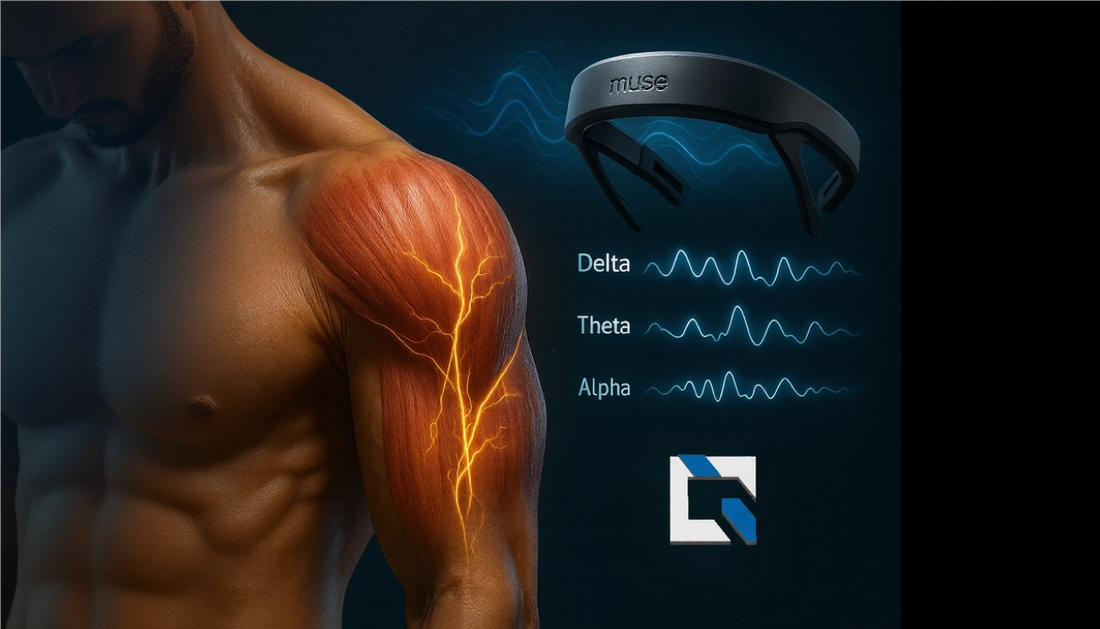
QS Technology and Neuromuscular Activation: Initial Results from a Pilot Study
Introduction
Q -Technology was designed to act as a catalyst for neuromuscular regulation and postural stabilization.
But how do we measure these effects?
To explore this question, an exploratory pilot study was conducted on August 16, 2025. It aimed to observe the influence of QS technology on:
- muscle stability,
- brain activity (EEG),
- and heart rate.
The muscle chosen: the left middle deltoid, used during a manual resistance test in abduction (arm raised to 90°).
Methodology
The experiment was conducted using the Muse Athena and the MindMonitor.
Two conditions were compared:
- Without QS : the muscle quickly gave way under pressure.
- With QS : the muscle resisted firmly twice in a row.
The recordings included:
- EEG activity (Delta, Theta, Alpha bands),
- heart rate,
- and the observed muscle stability.
Quantitative results (recorded averages)
|
Setting |
Without QS |
With QS |
Variation |
|
EEG Delta (AF8) |
0.654 |
0.953 |
↑ +45% |
|
EEG Theta (AF8) |
-0.235 |
-0.063 |
↓ |
|
EEG Alpha (TP9) |
0.022 |
0.020 |
≈ Stable |
|
Heart rate (BPM) |
79.8 |
82.8 |
+3 BPM |
|
Muscle stability |
Weak |
High |
Improved |
|
|
|
|
|
Interpretation
- Delta ↑ (AF8) : The significant increase in the Delta band in the presence of QS suggests a shift towards a parasympathetic regulatory and improved neurophysiological stability.
- Theta ↓ (AF8) : The reduction in Theta activity (often linked to confusion, stress, or low mental clarity) suggests an enhancement of cognitive alertness.
- Stable Alpha (TP9) : Constant alpha is often correlated with balanced mental calm, without drifting towards cerebral hyperactivity.
- Heart rate ↑ : Slight elevation, probably due to more efficient neuro-motor mobilization, rather than stress.
- Muscle stability : Without QS, the arm dropped rapidly. With QS, resistance was greatly increased, reflecting enhanced neuromuscular activation.
👉 These results highlight optimized neuromuscular integration and more stable brain synchronization in the presence of Q-Technology.
Discussion and perspectives
Even though this pilot study is limited to a single participant, the results are consistent with the initial hypotheses:
- improved muscle stability,
- modulation (EEG),
- and a direct functional impact on neuromotor performance.
These observations support the idea that Q-Technology does not only act on visible posture, but on brain-muscle communication itself.
In practice, this opens up interesting possibilities for:
- biohacking of daily performance,
- functional rehabilitation ( orthopedics, neurology),
- elite sport ,
- and even stress management and recovery.
What's the next step?
Larger-scale studies, with randomized and controlled protocols, to scientifically validate the impact of Q-Technology on neuromuscular optimization and human health.