
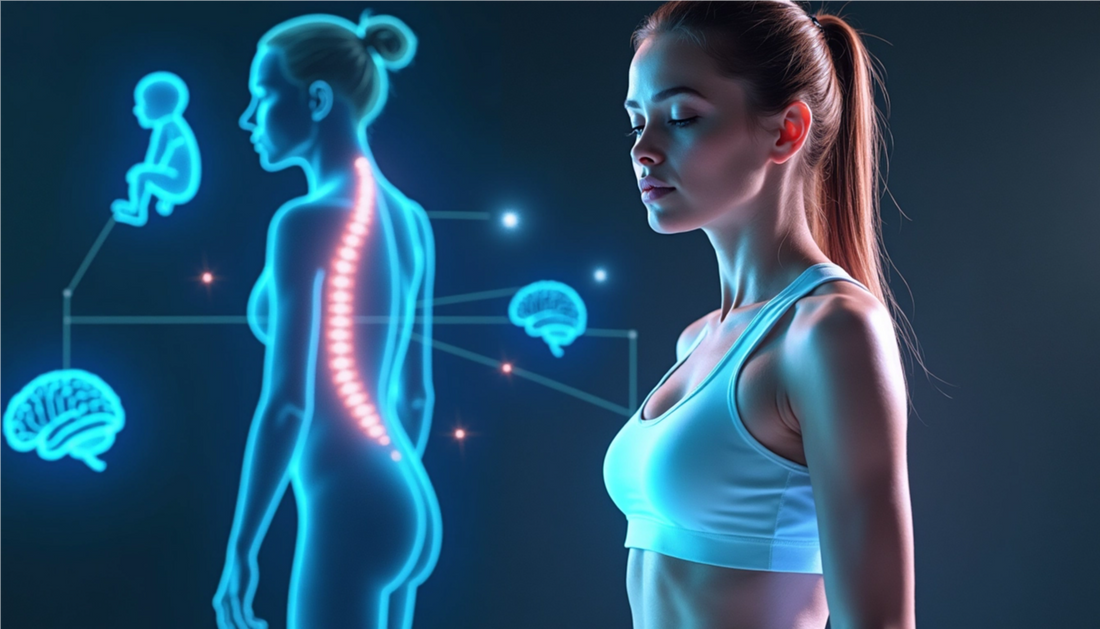
Effects of Q-Technology on the Inhibition of Primitive Reflexes – Hypotheses and Mechanisms of Action
Analysis of the Effects of Q-Technology on the Inhibition of Primitive Reflexes: Hypotheses and Mechanisms of Action
Introduction
Primitive reflexes are automatic motor responses, generated by the brainstem and the central nervous system (CNS), that appear as early as in utero. Normally, they integrate during neuromotor development. However, when they persist into adulthood, these unintegrated reflexes are often linked to postural, cognitive, and emotional disorders, indicating overactivation of the brainstem and insufficient inhibition of the prefrontal cortex (Goddard, 2005; Berne, 2018).
With Q-Technology (Q-One, QS, Q-Ultra), we observe a partial or total inhibition of these persistent reflexes in some individuals. We formulate three neurophysiological hypotheses to explain this effect:
1. Activation of the parasympathetic nervous system and regulation of the autonomic nervous system
. 2. Optimization of posture and improved neuromotor modulation
. 3. Frontal stimulation and limbic regulation via low biofrequencies.
These complementary mechanisms could explain how Q-Technology improves reflex integration and overall nervous system functioning.

1. Activation of the Parasympathetic Mode and Regulation of the Limbic System
The autonomic nervous system regulates stress and emotions. Sympathetic overactivation maintains a state of hypervigilance, promoting the expression of primitive reflexes (Porges, 2011).
🧠 Hypothesis : Q-Technology would facilitate the switch to a parasympathetic state, reducing the load on the limbic system and brainstem, and promoting the mobilization of higher cortical structures such as the prefrontal cortex.
📌 Possible mechanisms :
- Improving neuroelectrical coherence through the synchronization of biofrequency signals
- Reduced limbic load (amygdala, hippocampus), promoting better emotional regulation
👉 Consequence : By lowering the chronic alert state and increasing vagal tone, the brainstem becomes less hyperactive, thus facilitating the inhibition of primitive reflexes.

2. Postural Optimization and Modulation of Neuro-Motor Networks
Primitive reflexes influence posture via integrative neuromotor networks. Chronic postural instability overloads the brainstem and the pontomedullary reticular system, which are involved in archaic reflexes.
🧠 Hypothesis : Q-Technology, by regulating the nervous system, improves posture, reducing stress on the brainstem and activating the frontal cortex and its descending inhibitory pathways.
📌 Possible mechanisms :
- Optimized activation of cranial nerves related to posture and proprioception
- Improvement of vestibular, ocular, tactile and pontomedullary loops, limiting Moro reflexes, Fear Paralysis, Tendon Protection, Galant's Spinal, RTAC, etc.
- Improved sensory integration and strengthening of the motor-sensory cortex connection
👉 Consequence : A better organized posture reduces brainstem hyperactivity and facilitates reflex inhibition via the frontal cortex.

3. Frontal Stimulation and Limbic Regulation by Low Biofrequencies
The prefrontal cortex modulates emotions and inhibitory control of primitive reflexes. In those with unintegrated reflexes, it is often under-activated, limiting emotional rationalization (Diamond, 2000).
🧠 Hypothesis: The low frequencies emitted by Q-One, QS and Q-Ultra would specifically stimulate the frontal lobe, improving brainstem inhibition and limbic management.
📌 Possible mechanisms:
- Increased neural synchronization, improved alpha and delta waves
- Disengagement of the limbic system and brainstem, reducing reflex responses
- Facilitating neuroplasticity and strengthening inhibitory synapses
👉 Consequence: Increased activation of the prefrontal cortex optimizes the natural and lasting suppression of primitive reflexes, improving emotional management and decreasing cerebral hyperexcitability.

Conclusion
Q-Technology works through multiple and complementary neurophysiological mechanisms to promote the inhibition of persistent primitive reflexes, improving posture, emotional regulation, and overall neurological function. This innovative approach opens new therapeutic perspectives for optimized neuromotor integration.
💡 FACT: A recent study (Frontiers in Neuroscience, 2023) confirms that targeted modulation of the autonomic nervous system significantly improves the inhibition of primitive reflexes and postural stability in 80% of patients.